Showing posts with label Ecuadorian music. Show all posts

Wednesday, September 17, 2014

Zamora Chinchipe - Province in Southern Ecuador

Zamora Chinchipe is the southernmost province of Ecuador in Amazonian region  and it is located at the southeastern end of the Amazon Basin.

The province shares borders with the Ecuadorian provinces of Azuay and Morona Santiago to the north, Loja and Azuay to the west, and with Peru to the east and south.

The province comprises an area of approximately 10,456 km² and is covered with a uniquely mountainous topography which markedly distinguishes it from the surrounding Amazonian provinces.

Zamora-Chinchipe is characterized and largely identified by its mining industry; indigenous ethnic groups with a rich archaeological legacy; its biodiversity; and its niche and tourist attractions, which include a number of waterfalls well-noted for their beauty.

The province takes its name from the bureaucratic fusion of the Zamora and Chinchipe cantons.

The provincial capital is the city of Zamora.

Natural attractions in Zamora Chichipe include the Podocarpus National Park which is true extravagance of nature.

The vegetation is lush with virgin rain forest full of animals and birds.

National Park is home of many species of orchids and is one of the most biodiverse places in the world.


There is water everywhere; the jungle is filled with rivers, waterfalls, creeks and lagoons.

It is also very accessible and easy to navigate.


History of Zamora Chinchipe

Human habitation in the region is thought to date to at least 4500 BCE, and was grounded in the Mayo-Chinchipe cultural complex.

In approximately 1548, Spaniards made their first contact with the region's indigenous people.

On October 4, 1549, Hernando de Barahona, accompanied by Alonso de Mercadillo and Hernando de Benavente, founded the city of Zamora de los Alcaides.

Fifty years after their arrival, the Spanish were driven from the city by the Shuar revolt.

In 1850, the Zamora de los Alcaides city ruins were discovered by a group of colonists.

It cannot be established exactly when the first white and mixed race settlers arrived in the province.

But the oldest verifiable data shows that in the late 1840s, the Chinchipe River basin was already inhabited by people arriving from the Loja Province of modern Ecuador and Peru.


The migration was also made from the Ecuadorian Province of Azuay to the Yacuambi Canton, where the Saraguros and mixed race people arrived.

During the Spanish Colonial period, several explorers surveyed the territory, such as the French geographer and mathematician Charles Marie de La Condamine in a 1743 expedition.

In 1781, the Spanish made a second attempt at colonization in the area, lured by the exploitation of gold deposits, but they found it impossible to dominate the natives.

The current settlement known as Zamora was not permanently reestablished by white and mixed race settlers until March 12, 1921.

The Catholic Church founded the Apostolic Vicariate of Zamora, after many prior attempts at colonization, each repelled by the resistance of the Shuar people.

In 1911, the Zamora parish became cantonal head of the Zamora Canton of the Provincia de Oriente.

On December 15, 1920, the Santiago-Zamora Province was created, it consisted of the Chinchipe, Macas, Morona and Zamora cantons.


War with Peru


On July 5, 1941, Ecuador was invaded by Peru, with part of the unpopulated territory of the province in contention.

A ceasefire was brokered between the Foreign Ministers of Peru and Ecuador (with the participation of the United States, Brazil, Chile, and Argentina as "guarantors") capped with the signing of the Rio Protocol.

The treaty officially brought an end to the state of war which had existed between Ecuador and Peru, and left part of the Ecuadorian provinces of El Oro, Loja, and Zamora-Chinchipe under Peruvian occupation.

After the 1941 war, forced migration of impoverished peasants and citizens to the province was accelerated by drought in Loja Province.

This resulted in colonization of many areas of the Zamora-Chinchipe territory which had been theretofore uninhabited.

In 1981, the tensions with Peru were rekindled by a military confrontation over the Cenepa River in the Cordillera del Cóndor.

By 1995 the conflict had reemerged, and Peru and Ecuador were again fighting each other.

In 1999 the signing of the Peace Agreement between Ecuador and Peru settled the contours of Zamora-Chinchipe's borders with its southern neighbor.


The war is still remembered in the province and fear of new attacks from Peru remain, even though the new generations know of the confrontation only from stories, history and the monuments.

Friday, September 5, 2014

Chaucha Kings - Ecuadorian Music


Chaucha Kings, is the result of the union of three of the most popular and representative groups of the Ecuadorian contemporary music of recent times: Cruks in Karnak, Caceria de Lagartos and Tomback.

This project shows that artists from different tendencies can combine their talents with the simple urge to create and project a good rock’n’roll message: share and enjoy.

In the beginning the Chaucha Kings, thought of forming the band as a short time project to make music until their respective groups got back together again.

But the group has had such a huge public acceptance, throughout the country, that we undoubtedly now have Chaucha for long.

Chaucha is a word derived from Quechua and/or Kichwa, that means immature.

It has a different meaning in different parts of South America from little potatoes, to green beans with also some sexual connotation in Argentina.

In Ecuador chaucha means both little potatoes, and chauchipapas, or French fries with little sausages, are very popular here.

But it also means a second job that you do because you don’t enough in the first one and this is the true meaning of the group’s name.

It is in honor of countless Ecuadorians that have had to do two jobs to be able to bring the bread and potatoes to their families.

Many of Chaucha Kings songs reflect this reality, and they sing popular Ecuadorian music with lyrics about going away to get a better job, either to another part of Ecuador or as an immigrant to another country.

They also sing about popular fiestas or parties in Ecuador and about broken hearts, which are all part of the life of Ecuadorians.

The group’s message is share your life and enjoy it with others, an integral part of Ecuadorian culture.


But it has another even more profound message, be proud of Ecuador, of your culture and of being an Ecuadorian.


LA VIDA ENTERA - Chaucha Kings & Rocko y Blasty


Chaucha kings - Delfin Quishpe - CANELAZO


Volverte a ver - Chaucha Kings y Widinson (Juan Fernando Velazco)


Chaucha Kings Tabaco y Ron


CHAUCHA KINGS CON ALADINO "LLORARÁS POR MI"

Wednesday, June 4, 2014

Ecuadorian traditional music - Wednesday facts


Ecuadorians love music and it is a huge part of their culture.

They love to listen to it on the streets, in homes, at parties, and on buses—if you’re traveling in Ecuador, you're going to hear plenty of different sounding rhythms from modern to traditional Ecuadorian folk music.

And they love to dance to it, there cannot be music without dancing.

Ecuador is home to a number of cultures, including the Mestizo culture and a unique blend of Afro-Ecuadorian culture.

Afro-Ecuadorians are the descendants of African slaves who worked on the coastal sugar plantations in the sixteenth century.

The Afro-Ecuadorians that are present in Ecuador today are famous for their marimba music as well as their many music and dance festivals.

Long before the Spanish had conquered Ecuador, and even before the rise of the Inca civilization, the diverse native cultures of the region had rich musical traditions.

It is clear that music has always played an important role in the ancient Andean people’s lives as archaeologists have found some very old instruments, such as drums, flutes, trumpets and other musical artifacts, in ancient tombs.

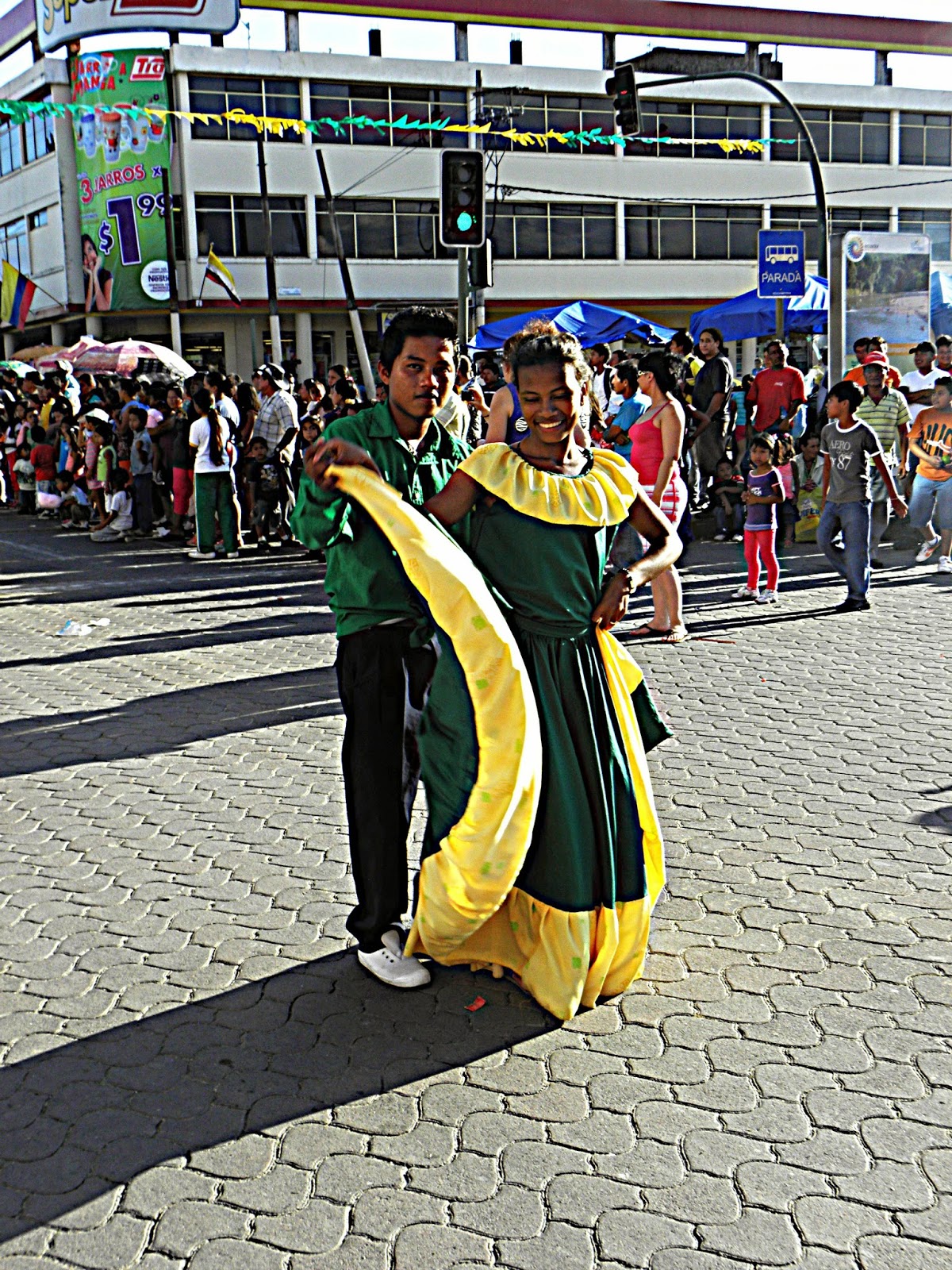
In tourist areas such as Otavalo or Baños, you’re bound to encounter a native band (called a grupo or conjunto) composed of anywhere from four to 10 Ecuadorians, often dressed in native clothing, playing folkloric songs on traditional instruments.

The group is bound to have at least one guitarist, a drummer and at least one musician producing a haunting melody on a panflute, a traditional Andean instrument composed of varying lengths of bamboo lashed together.

In towns like Baños, the groups make the rounds of the more expensive tourist restaurants, stopping by and playing three or four songs, then passing the hat for tips and selling CDs of their music.

Some fancier places, such as haciendas that have been converted into hotels, have their own native bands that play for guests in the evening and during dinner.

If you’re lucky enough to get invited to a private party or make it to a local festival, you may see a banda del pueblo.

These bands are composed of locals who get together on special occasions to play mostly traditional music.

The instruments are often old and fairly beat up, and occasionally the musical talent is questionable, but whatever they may lack in skill or instruments they more than make up for in exuberance and volume.

Here are five songs, five groups, and five styles, a composition of variety, just like Ecuador.

1. Andean music


 ´

The haunting sounds of bamboo pipes have formed a part of the Andean landscape for over two millennia. The Andean melodies most people are exposed to today, however, are a result of centuries of colonialism and the migrations of peoples from different regions and continents.

Many people associate indigenous Andean instruments to the time of the Inca. Flutes are generically labeled “Inca Pan-Pipes” and the images of Macchu Picchu are conjured up in the imagination. While the Incas certainly employed the instruments we know as “Andean”, it is important to understand that many cultures preceded the Inca dynasty, and with those cultures flourished music and instrumentation that the Incas merely inherited.

“Traditional” Andean music is not soft, melodious or soothing. Rather, it is raucous and loud, bordering on discordant. It almost always includes the playing of large bass drums (italaques and wangaras), snare drums, and at least a dozen flute players employing pipes of different sizes and tunings.


2. Banda de pueblo or Albazo


Albazo is a kind of Andean Ecuadorian music. It is of indigenous and mestizo origin. It has a happy rhythm and generally it is played with guitar and requinto. It is also common that it is played by a “banda de pueblo”village band.

Albazo is a rhythm that is related generally to a music band called “banda de pueblo” which walk the streets during the festivities at dawn. That is why, its name comes from this part of the day plus the suffix –azo, augmentative character. 

Originally it was indiginous wedding music. Today it is listened and played is some cantons of the Chimborazo, Pichincha and Tungurahua province. Songs as Desdichas, Avecilla, Taita salasaca, Triste me voy, Se va mi vida and Esta guitarra vieja represent this music genre.


3. Shuar music from the Amazon


 Amazonic Kichwa music


The amazonic music is a mix of traditional rhythms, sounds and instruments from the Amazon cultures with modern, Spanish and Andean ones.

Parts of the music might be recognizable for people from the past but mostly it has been changed by the times.

Even though, it still mantains its strangeness to an ear used to european/african music that our western music is.


4. Bomba from Valle de Chota


Bomba from Chota is an Afro genre originally from the Chota Valley, that is located between the limits of the Imbabura and Carchi province. It is a rhythm created by the majority of the afro- Ecuadorian population from that area. Usually it is play with drums and Spanish instruments as guitar, requinto or guiro. The rhythm and the speed can oscillate between a light dance and a rapid intensity of many Afro rhythms with erotic forms. Another variation is the Banda Mocha which at its beginnings was composed by primitive instruments such as tree orange leaves, flutes, bowie knife, drum and cornet made of dry pumpkin, and also cigar, nags, comb, etc.

Some foreign genres were welcome in our country but when they were introduced in the national imaginary they were transformed. It is the case of the “Fox Incaico” whose name is dispute because of the features it acquired during its evolution.

We can say that it is a genre that arise in the first decades of the twentieth century with two variations: Fox Trot and the combination with melodies composed inside the Andean pentaphony, which resulted in a sort of San Juanito with different rhythmic accompaniment.  The Fox Incaico exists in Peru and Ecuador. In our country several composers created the habit of giving them titles and themes of indigenous roots.


5. San Juanitos


San Juanito is an Ecuadorian indigenous genre of Andean music. It was very popular in the twentieth century; it is a genre native to the province of Imbabura.

It is a happy and danceable genre that is played in the festivities of the mestizo and indigenous culture in Ecuador. “San Juanito” has a pre- Inca origin.

The Ecuadorian musicologist Luis Moreno guesses that San Juanito got its name because this music used to be danced at the birthday of St. Juan Baptist, a festivity established by the Catholic Church on June 24 to coincide with indigenous ritual of Inti Raymi.


It has morphed from its original form into the music to play in the popular fiestas, sounding many times very different from the concept of Andean music. As you can hear comparing these two different versions of the same song, Karaway.