Wednesday, June 4, 2014

Ecuadorian traditional music - Wednesday facts


Ecuadorians love music and it is a huge part of their culture.

They love to listen to it on the streets, in homes, at parties, and on buses—if you’re traveling in Ecuador, you're going to hear plenty of different sounding rhythms from modern to traditional Ecuadorian folk music.

And they love to dance to it, there cannot be music without dancing.

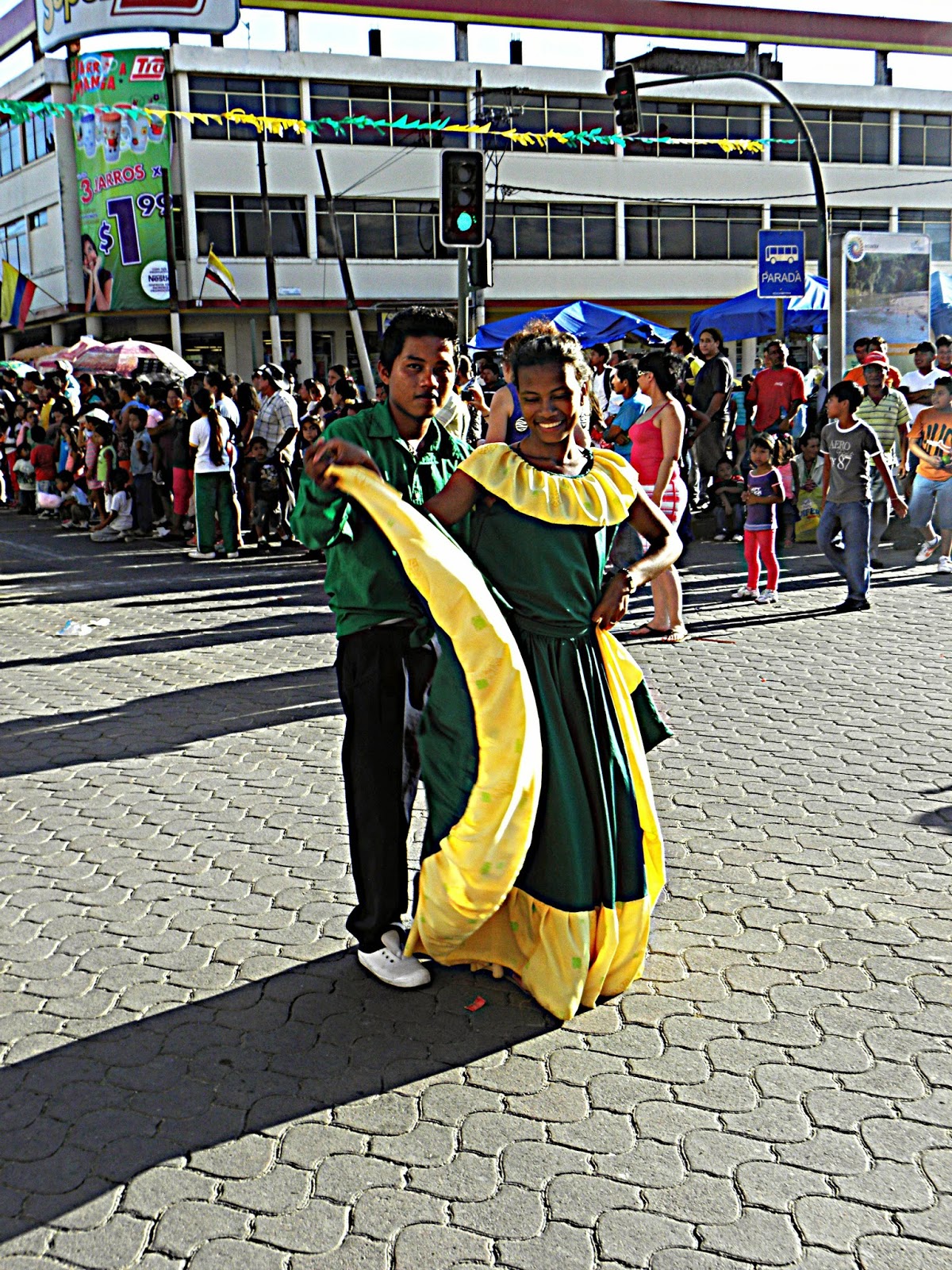
Ecuador is home to a number of cultures, including the Mestizo culture and a unique blend of Afro-Ecuadorian culture.

Afro-Ecuadorians are the descendants of African slaves who worked on the coastal sugar plantations in the sixteenth century.

The Afro-Ecuadorians that are present in Ecuador today are famous for their marimba music as well as their many music and dance festivals.

Long before the Spanish had conquered Ecuador, and even before the rise of the Inca civilization, the diverse native cultures of the region had rich musical traditions.

It is clear that music has always played an important role in the ancient Andean people’s lives as archaeologists have found some very old instruments, such as drums, flutes, trumpets and other musical artifacts, in ancient tombs.

In tourist areas such as Otavalo or Baños, you’re bound to encounter a native band (called a grupo or conjunto) composed of anywhere from four to 10 Ecuadorians, often dressed in native clothing, playing folkloric songs on traditional instruments.

The group is bound to have at least one guitarist, a drummer and at least one musician producing a haunting melody on a panflute, a traditional Andean instrument composed of varying lengths of bamboo lashed together.

In towns like Baños, the groups make the rounds of the more expensive tourist restaurants, stopping by and playing three or four songs, then passing the hat for tips and selling CDs of their music.

Some fancier places, such as haciendas that have been converted into hotels, have their own native bands that play for guests in the evening and during dinner.

If you’re lucky enough to get invited to a private party or make it to a local festival, you may see a banda del pueblo.

These bands are composed of locals who get together on special occasions to play mostly traditional music.

The instruments are often old and fairly beat up, and occasionally the musical talent is questionable, but whatever they may lack in skill or instruments they more than make up for in exuberance and volume.

Here are five songs, five groups, and five styles, a composition of variety, just like Ecuador.

1. Andean music


 ´

The haunting sounds of bamboo pipes have formed a part of the Andean landscape for over two millennia. The Andean melodies most people are exposed to today, however, are a result of centuries of colonialism and the migrations of peoples from different regions and continents.

Many people associate indigenous Andean instruments to the time of the Inca. Flutes are generically labeled “Inca Pan-Pipes” and the images of Macchu Picchu are conjured up in the imagination. While the Incas certainly employed the instruments we know as “Andean”, it is important to understand that many cultures preceded the Inca dynasty, and with those cultures flourished music and instrumentation that the Incas merely inherited.

“Traditional” Andean music is not soft, melodious or soothing. Rather, it is raucous and loud, bordering on discordant. It almost always includes the playing of large bass drums (italaques and wangaras), snare drums, and at least a dozen flute players employing pipes of different sizes and tunings.


2. Banda de pueblo or Albazo


Albazo is a kind of Andean Ecuadorian music. It is of indigenous and mestizo origin. It has a happy rhythm and generally it is played with guitar and requinto. It is also common that it is played by a “banda de pueblo”village band.

Albazo is a rhythm that is related generally to a music band called “banda de pueblo” which walk the streets during the festivities at dawn. That is why, its name comes from this part of the day plus the suffix –azo, augmentative character. 

Originally it was indiginous wedding music. Today it is listened and played is some cantons of the Chimborazo, Pichincha and Tungurahua province. Songs as Desdichas, Avecilla, Taita salasaca, Triste me voy, Se va mi vida and Esta guitarra vieja represent this music genre.


3. Shuar music from the Amazon


 Amazonic Kichwa music


The amazonic music is a mix of traditional rhythms, sounds and instruments from the Amazon cultures with modern, Spanish and Andean ones.

Parts of the music might be recognizable for people from the past but mostly it has been changed by the times.

Even though, it still mantains its strangeness to an ear used to european/african music that our western music is.


4. Bomba from Valle de Chota


Bomba from Chota is an Afro genre originally from the Chota Valley, that is located between the limits of the Imbabura and Carchi province. It is a rhythm created by the majority of the afro- Ecuadorian population from that area. Usually it is play with drums and Spanish instruments as guitar, requinto or guiro. The rhythm and the speed can oscillate between a light dance and a rapid intensity of many Afro rhythms with erotic forms. Another variation is the Banda Mocha which at its beginnings was composed by primitive instruments such as tree orange leaves, flutes, bowie knife, drum and cornet made of dry pumpkin, and also cigar, nags, comb, etc.

Some foreign genres were welcome in our country but when they were introduced in the national imaginary they were transformed. It is the case of the “Fox Incaico” whose name is dispute because of the features it acquired during its evolution.

We can say that it is a genre that arise in the first decades of the twentieth century with two variations: Fox Trot and the combination with melodies composed inside the Andean pentaphony, which resulted in a sort of San Juanito with different rhythmic accompaniment.  The Fox Incaico exists in Peru and Ecuador. In our country several composers created the habit of giving them titles and themes of indigenous roots.


5. San Juanitos


San Juanito is an Ecuadorian indigenous genre of Andean music. It was very popular in the twentieth century; it is a genre native to the province of Imbabura.

It is a happy and danceable genre that is played in the festivities of the mestizo and indigenous culture in Ecuador. “San Juanito” has a pre- Inca origin.

The Ecuadorian musicologist Luis Moreno guesses that San Juanito got its name because this music used to be danced at the birthday of St. Juan Baptist, a festivity established by the Catholic Church on June 24 to coincide with indigenous ritual of Inti Raymi.


It has morphed from its original form into the music to play in the popular fiestas, sounding many times very different from the concept of Andean music. As you can hear comparing these two different versions of the same song, Karaway.


We are not slaves to the sin - (Not so) Wordless Wednesday


“Well then, should we keep on sinning so that God can show us more and more of his wonderful grace? Of course not! Since we have died to sin, how can we continue to live in it? …We know that our old sinful selves were crucified with Christ so that sin might lose its power in our lives. We are no longer slaves to sin. For when we died with Christ we were set free from the power of sin.” 

Romans 6:1-2, 6-7

Tuesday, June 3, 2014

New leaders for Ecuador's indigenous people


Ecuador’s indigenous people chose their new leaders for the next three years.

Last week’s inauguration ceremony was followed by news, TV, and radio stations around the nation.

A huge difference from earlier times when indigenous nations weren’t considered to play any kind of part in Ecuador.

The ceremony was a mix of modern and ancient.

Filled with cultural expressions that used to be prohibited and followed only in secrecy.

The power changed hands literally when the old president, Humberto Cholango, passed the staff of power to the new president, Jorge Herrera, Kichwa from Cotopaxi.

The new leaders were sworn to their position in front of the sacred fire.
My friend Katy Machoa, Amazonic Kichwa of Napo, the leader for women and families in CONAIE.

The Confederation of Indigenous Nationalities of Ecuador (CONAIE)


There exists currently a struggle for people's identity, to regain their rights, here, in the continent, and in the world.

The indigenous people of Ecuador do not believe that this struggle should be violent, as that will not take us anywhere.

Ecuadorian indigenous people consider that as indigenous peoples, as the original peoples of the world, they have their own identity as their only reference point.

The principle of identity, which represents the present struggle of the Peoples of the world, is gaining strength internationally.

When speaking identity it does not refer only to the culture of which we are the bearers, but also to the methods of nourishment, way of life, social organization, the way in which we see the world, etc.

This global perspective allows seeing beyond certain political dogmas that have been imposed upon us.

The indigenous movement, with its search for the principles of identity, could serve as a reference point for the rest of Ecuadorian society, since it is a project not only for us but for everyone.

The indigenous problem concerns all Ecuadorians, the government and the governed.

Now that there is no political orientation, the struggle for identity, to know who we are, to recuperate our roots-if indeed we have lost them could provide the way in which we can walk strongly, and firmly into the future.

Since its formation in 1986, CONAIE has led the Indigenous peoples of Ecuador from relative isolation to a position at center stage of Ecuadorian society.
The staff of power, the old president Humberto Cholango passes on the power to the new president Jorge Herrera while reminescing about the last three years and the struggle of indigenous people in Ecuador and South America.

CONAIE is the representative body that guarantees Indigenous people the political voice that has too long been denied them, and that expresses their needs and goals within a rapidly changing world.


In Ecuador, during 170 years of republicanism, it has been wrongly asserted that this is a homogeneous country, made of only one nationality, as the old national Constitution insisted.

That, however, is not the reality.

Many peoples have always lived here, each with its own culture, its own language, its own customs.

Some of these peoples have disappeared, others are in danger of disappearing, and some of us are very much alive.

The indigenous nationalities of Ecuador have always had community and family as the basis of our social organization.

From that base has grown the necessity to form relationships with other communities of the zone, the province and the region.

For that reason they have formed the zonal, provincial and regional organizations.

In order for thier voice to be heard at the national level, they have formed the organization that now represents them, CONAIE, in 1986.

CONAIE represents all of the indigenous nationalities of the country, some organized into provincial organizations, and others not.
 
At the extreme left the leader for Youth Organization (Otavalo Kichwa), next the leader of Women and Families (Amazonic Kichwa of Napo), the thrid from left leader for Territories (Shuar), the second from the right leader for Organizational Streghtening (Shuar) and the extreme right the leader for Education and Culture (Chachi).
The Confederation of Indigenous Nationalities of Ecuador (Spanish: La Confederación de Nacionalidades Indígenas del Ecuador) or more commonly, CONAIE, is Ecuador's largest indigenous organization.

Formed in 1986, CONAIE has pursued social change on behalf of the region's significant native population using a wide range tactics including direct action.

 CONAIE is most well known for its organization of popular uprisings ("levantamientos populares") that often include blockading of commercial arteries and the takeover of government buildings.

At the moment of the formation of the organization, indigenous people felt that it had two urgent tasks: land and education.

Along with the resolution of the many land problems that have been waiting for years, the indigenous nations have pushed for the bilingual education program to be organized by CONAIE.

They have succeeded in signing an agreement between CONAIE and the Ministry of Education and Culture that is still functioning today.

In this way they have been able to unify the Kichwa language, and they now want to carry this project further with other indigenous languages.
New leader for Health and Nutrition, a Salasaka Kichwa, wearing the symbols of indigenous people of Ecuador, the rainbow and Andean cross (Chakana).

Within the movement that has been carrying on there has been discussions to define terms such as nationality, Peoples, 'campesinos', Indians, indigenous.


The indigenous people have also come to differentiate the meaning of land and territory for indigenous peoples.

The debates are continuing to clarify these concepts.

These discussions have contributed to a growing sense of self- identification, and of pride in belonging to a people.

This is reflected as well in the understanding of the rest of the nation when they no longer, out of ignorance, use pejorative terms such as aucas when referring the Waorani, jibaros when referring to the Shuar, colorados instead of Tsachilas, or cayapas instead of Chachi.

The word Indian is still used in general, but there will come a time when each nationality will be referred to by its own name.

CONAIE represents the following indigenous peoples: Shuar, Achuar, Siona, Secoya, Cofán, Waorani, Záparo, Chachi, Tsáchila, Awá, Epera, Manta, Wancavilca and Kichwa.
The positioning of a new shuar leader.

CONAIE is composed of three regional federations:


the Confederation of Indigenous Nationalities of the Ecuadorian Amazon (Confederación de Nacionalidades Indígenas de la Amazonía Ecuatoriana; CONFENIAE) in the eastern Amazon region or Oriente;

The Confederation of Peoples of Kichua Nationality in the central mountain region (Confederación de Pueblos de la Nacionalidad Kichuas del Ecuador; ECUARUNARI);

and the Coordination of Indigenous and Black Organizations of the Ecuadorian Coast (Coordinadora de Organizaciones Indígenas y Negras de la Costa Ecuatoriana; CONAICE).

CONAIE's political agenda includes the strengthening of a positive indigenous identity, recuperation of land rights, environmental sustainability, opposition to neoliberalism and rejection of U.S. military involvement in South America.