Showing posts with label indigenous people. Show all posts

Sunday, January 17, 2016

Taita Imbabura and Mama Cotacachi


Each region of Ecuador has its own myths and legends.

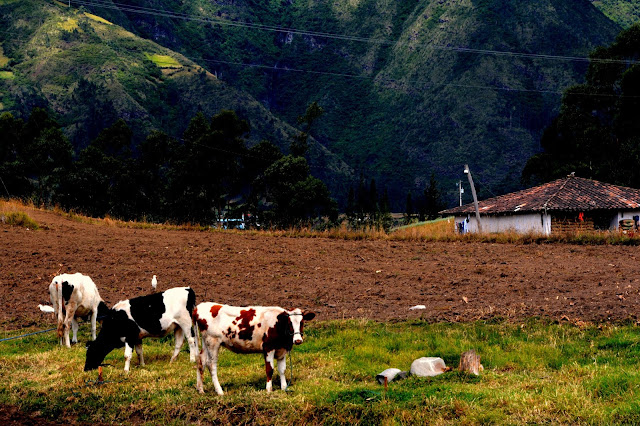
In Imbabura Province, many of the legends center around the love affair between the volcanoes Taita Imbabura and Mama Cotacachi.


Imbabura is the male protector mountain. He is sometimes known as Manuel Imbabura. The female protector mountain is María Isabel Cotacachi.

When Imbabura was young, he would sometimes walk alone at night, hoping no one would recognize him and criticize him for not being at home.


One night, he came across María Cotacachi. Later, they would walk together. But Imbabura had a hard time telling her how much he loved her. One day, he finally declared his love. Cotacachi confessed she had the same feelings.
As time passed, they would have a son called Yanaurcu who sits near his mother. There is a real mountain called Yanaurcu.


Today, the indigenous make offerings to María Cotacachi and Manuel Imbabura, hoping the two can ensure a good harvest.
It is said when Cotacachi has snow in the morning, it's because Imbabura came to visit her at night.

Sunday, January 10, 2016

The Children of the Year - Waka Wawa


Napu runa, the Amazonian Kichwa people of Ecuador, tell that the group of stars that they call Wata or Year (the constellation of Pleiades), were children before.

 In total there were three of them, two boys and a girl. They lived in the jungle together with Yaya Apustulu. He was a friend of God who had been left on the earth to take care of the Napu runa.


Wata Wawa, or the Children of the Year, had a grandmother who was a screech owl, called Wakawa. In that time the brothers Killa, the moon, and Inti, the sun, still lived on the earth with the rest of the people. As did all of the stars and many animals.

Wakawa had not become an owl yet but she was married and lived with her husband. One day her husband left her to go to the jungle to build a trap for the animals.


When he left he said to his wife: If, for a chance, I might die in the trap, you must rip my penis out to bury it.

He made the trap and since he was a little slow on though he got inside of it to try it. The trap fell on him and crushed him. Back at the home Wakawa could hear her husband cry.


Old Wakawa ran to see him and found him already dead. As her husband had said, she ripped his penis, buried it and hid it under a jar.

In the ground a sapana grew. Sapana is a large earthworm that looks very much like a penis.


Every morning the grandmother would wake up to go release herself. She would move the jar and squat on the earth.

In the afternoon, after she had bathed, she would do the same thing. Her grandchildren could see this. And they would ask each other: Why grandmother squats on earth like that? It can’t be grandfather because he is dead. Let’s go see!


One of the brothers removed the jar and said to his sister: There’s a worm here. Let’s throw it away. You sit on it and we’ll get the rope.

They span cotton and made a rope from it. They tied the rope over the hole in the earth and each brother grabbed a hold of one extreme.


When they were ready, their sister squatted over the hole exactly as their grandmother used to do.

They beat the earth and sapana started to come out. Instantly the two brothers tightened the rope and tied the worm and pulled it out.


The boys threw the worm against the thorny trunk of a chambira tree. The noise could be heard far away.

Their grandmother was working on the chakra, sowing corn. When she heard the noise, she came back shouting: They are killing the grandfather!


While she came towards the house running, the Wata Wawa made a ladder from wood they found in the jungle. And they were ascending to heaven as fast as they could.

The sister was carrying a basket and in the basket there was a piwichu bird. The bird was singing all the way up.


They were already up in the sky when their grandmother finally reached the house. She shouted at them: Why have you left me? Come back children! Don’t leave me!

The grandmother cried and cried while she watched her grandchildren disappearing between the clouds.


On the sky the children, the basket and the piwichu all became stars. When the grandmother saw this she said: What will I turn into? I will become Wakawa!

Then she lifted up on her wings and flew away, screeching: Wakawa! Wakawa!

In her beak she carried the penis of her husband. And from that day on the screech owl lives eating snakes and worms. It is Wakawa, the grandmother who was left alone and now cries her sorrows in the night.

Wednesday, April 1, 2015

Shuar Indigenous People of Ecuador


The Shuar indigenous people of Ecuador were an eminently warlike people.

They were known as the feared Jíbaros, the wilds or ferals, and headhunters of the Amazon.


Formerly, after their wars, they performed a rite of reducing the head of his enemies.

This ritual is known as Tsantsa.


It was performed in order to preserve the enemy’s head as a trophy of war.

Today they claim the right to call themselves as Shuar, meaning, people, a person.


History of Shuar People


These dreaded “feral” people dominated the Amazon jungle to the late nineteenth century.

They lived mainly in the provinces of Morona Santiago and Zamora Chinchipe of Ecuador.


Shuar nation was never submitted by the colonizers.

The arrival of the Salesian mission, which gained momentum after 1930, led to the nuclearization of settlements and new forms of organization.


This culminated in the establishment of the Shuar Federation in 1964.

The Salesian missionaries began the process of Christianizing the Shuar.


The first missionaries were seized by the feared warriors and found their end in the hands of the Shuar warriors.

Although Western history does not indicate how many missionaries were killed and legendary transformed into tsantsas.


Nowadays the Shuar have left their warrior side and submitted to the pacification imposed by missionaries.

In this process, several Shuar fled to the south, and this way expanded the communities to different areas of Amazonian Ecuador.


Such as the provinces of Pastaza, Morona Santiago, Zamora Chinchipe, and to the territory that now corresponds to Peru.


Culture of the Shuar Nation


The traditional language of Shuar people is Shuar-chicham.

 They are nomads and subsist mainly on the horticulture of tubers, tending the farms until the harvest and then moving on.


This is supplemented by hunting, fishing and gathering which are the work of the men.

The agriculture and harvesting are for women.


Women are also in charge of children and housework, particularly of the preparation of chicha and kitchen.

The Shuar people traditionally use the system of slash and burn cultivation.


Hunting is their main source of protein, and they supplement their diet with fishing and gathering fruits, insects and plants.

However, currently most of the traditional hunting ground is being replaced by cattle pastures, which has resulted in the progressive depletion of the soil and reduced availability of land.


This has led to the introduction of a sedentary settlement pattern, the same that is producing changes in the socioeconomic system.


Traditionally the settlement was sparse, usually zoned according to kinship.


Thursday, June 5, 2014

Split-Second Story - Photo Challenge

An indigenous woman from Salasaka Kichwa nation prepares the sacret fire for the inauguration of the new indigenous leaders of CONAEI, Ecuador's largest indigenous organization.

Ecuadorian indigenous nations struggle to maintain their own cultures and languages in the pressure by the outside mainstream Ecuadorian and Latin, or hispanic as it is called in Ecuador, culture.

CONAIE was created to bring the different nationalities together and use it to generate political pressure in questions of importance to indigenous people.

The design of the resting place for the sacred fire is ancient and meaningful.
The sacred fire sits on top of flowers formed as chakana, the Andean cross, age-old emblem of Andean indigenous people.

Starting from the chakana, the flowers, petals and fruits together form a spiral, a symbol for cornucopia.

Cornucopia in itself is a symbol of plenitud, abundance and fertility, all of this is evoked by the design.

Next to the flower chakana is a pilche (or drinking cup) filled with chicha, an Ecuadorian fermented drink token for life.

Only women, as givers of life are permitted to participate in the making of chicha and serving it.

On the rainbow colored fabric rests the staff of power, symbol for the CONAEIs and its leaders power, given to it by the different indigenous nations.

The rainbow is another emblem for the indigenous people of Ecuador and South America.

It symbolizes the multiethnicity and multiculturality of the country and continent.

Rainbow has also many older meanings, most of the indigenous nations have beliefs about rainbows, and it has a huge significance in the old religions.

In the Amazon, rainbow is Amarun, the boa, the lizard that watches over you and keeps you safe.

Or it can also be a dangerous foe and your end, if you anger it.

The form of boa can be also seen in the spiral and together with cornucopia it signifies abundance and the gifts of the earth.

For the Amazon people, boas can be turned into people and people can be turned into boas and they still maintain communication with the boas.

It is important to ask permission from the boa who owns the territory before entering it, or building your house there.

Tuesday, June 3, 2014

New leaders for Ecuador's indigenous people


Ecuador’s indigenous people chose their new leaders for the next three years.

Last week’s inauguration ceremony was followed by news, TV, and radio stations around the nation.

A huge difference from earlier times when indigenous nations weren’t considered to play any kind of part in Ecuador.

The ceremony was a mix of modern and ancient.

Filled with cultural expressions that used to be prohibited and followed only in secrecy.

The power changed hands literally when the old president, Humberto Cholango, passed the staff of power to the new president, Jorge Herrera, Kichwa from Cotopaxi.

The new leaders were sworn to their position in front of the sacred fire.
My friend Katy Machoa, Amazonic Kichwa of Napo, the leader for women and families in CONAIE.

The Confederation of Indigenous Nationalities of Ecuador (CONAIE)


There exists currently a struggle for people's identity, to regain their rights, here, in the continent, and in the world.

The indigenous people of Ecuador do not believe that this struggle should be violent, as that will not take us anywhere.

Ecuadorian indigenous people consider that as indigenous peoples, as the original peoples of the world, they have their own identity as their only reference point.

The principle of identity, which represents the present struggle of the Peoples of the world, is gaining strength internationally.

When speaking identity it does not refer only to the culture of which we are the bearers, but also to the methods of nourishment, way of life, social organization, the way in which we see the world, etc.

This global perspective allows seeing beyond certain political dogmas that have been imposed upon us.

The indigenous movement, with its search for the principles of identity, could serve as a reference point for the rest of Ecuadorian society, since it is a project not only for us but for everyone.

The indigenous problem concerns all Ecuadorians, the government and the governed.

Now that there is no political orientation, the struggle for identity, to know who we are, to recuperate our roots-if indeed we have lost them could provide the way in which we can walk strongly, and firmly into the future.

Since its formation in 1986, CONAIE has led the Indigenous peoples of Ecuador from relative isolation to a position at center stage of Ecuadorian society.
The staff of power, the old president Humberto Cholango passes on the power to the new president Jorge Herrera while reminescing about the last three years and the struggle of indigenous people in Ecuador and South America.

CONAIE is the representative body that guarantees Indigenous people the political voice that has too long been denied them, and that expresses their needs and goals within a rapidly changing world.


In Ecuador, during 170 years of republicanism, it has been wrongly asserted that this is a homogeneous country, made of only one nationality, as the old national Constitution insisted.

That, however, is not the reality.

Many peoples have always lived here, each with its own culture, its own language, its own customs.

Some of these peoples have disappeared, others are in danger of disappearing, and some of us are very much alive.

The indigenous nationalities of Ecuador have always had community and family as the basis of our social organization.

From that base has grown the necessity to form relationships with other communities of the zone, the province and the region.

For that reason they have formed the zonal, provincial and regional organizations.

In order for thier voice to be heard at the national level, they have formed the organization that now represents them, CONAIE, in 1986.

CONAIE represents all of the indigenous nationalities of the country, some organized into provincial organizations, and others not.
 
At the extreme left the leader for Youth Organization (Otavalo Kichwa), next the leader of Women and Families (Amazonic Kichwa of Napo), the thrid from left leader for Territories (Shuar), the second from the right leader for Organizational Streghtening (Shuar) and the extreme right the leader for Education and Culture (Chachi).
The Confederation of Indigenous Nationalities of Ecuador (Spanish: La Confederación de Nacionalidades Indígenas del Ecuador) or more commonly, CONAIE, is Ecuador's largest indigenous organization.

Formed in 1986, CONAIE has pursued social change on behalf of the region's significant native population using a wide range tactics including direct action.

 CONAIE is most well known for its organization of popular uprisings ("levantamientos populares") that often include blockading of commercial arteries and the takeover of government buildings.

At the moment of the formation of the organization, indigenous people felt that it had two urgent tasks: land and education.

Along with the resolution of the many land problems that have been waiting for years, the indigenous nations have pushed for the bilingual education program to be organized by CONAIE.

They have succeeded in signing an agreement between CONAIE and the Ministry of Education and Culture that is still functioning today.

In this way they have been able to unify the Kichwa language, and they now want to carry this project further with other indigenous languages.
New leader for Health and Nutrition, a Salasaka Kichwa, wearing the symbols of indigenous people of Ecuador, the rainbow and Andean cross (Chakana).

Within the movement that has been carrying on there has been discussions to define terms such as nationality, Peoples, 'campesinos', Indians, indigenous.


The indigenous people have also come to differentiate the meaning of land and territory for indigenous peoples.

The debates are continuing to clarify these concepts.

These discussions have contributed to a growing sense of self- identification, and of pride in belonging to a people.

This is reflected as well in the understanding of the rest of the nation when they no longer, out of ignorance, use pejorative terms such as aucas when referring the Waorani, jibaros when referring to the Shuar, colorados instead of Tsachilas, or cayapas instead of Chachi.

The word Indian is still used in general, but there will come a time when each nationality will be referred to by its own name.

CONAIE represents the following indigenous peoples: Shuar, Achuar, Siona, Secoya, Cofán, Waorani, Záparo, Chachi, Tsáchila, Awá, Epera, Manta, Wancavilca and Kichwa.
The positioning of a new shuar leader.

CONAIE is composed of three regional federations:


the Confederation of Indigenous Nationalities of the Ecuadorian Amazon (Confederación de Nacionalidades Indígenas de la Amazonía Ecuatoriana; CONFENIAE) in the eastern Amazon region or Oriente;

The Confederation of Peoples of Kichua Nationality in the central mountain region (Confederación de Pueblos de la Nacionalidad Kichuas del Ecuador; ECUARUNARI);

and the Coordination of Indigenous and Black Organizations of the Ecuadorian Coast (Coordinadora de Organizaciones Indígenas y Negras de la Costa Ecuatoriana; CONAICE).

CONAIE's political agenda includes the strengthening of a positive indigenous identity, recuperation of land rights, environmental sustainability, opposition to neoliberalism and rejection of U.S. military involvement in South America.