Showing posts with label Ecuador. Show all posts

Sunday, January 17, 2016

Taita Imbabura and Mama Cotacachi


Each region of Ecuador has its own myths and legends.

In Imbabura Province, many of the legends center around the love affair between the volcanoes Taita Imbabura and Mama Cotacachi.


Imbabura is the male protector mountain. He is sometimes known as Manuel Imbabura. The female protector mountain is María Isabel Cotacachi.

When Imbabura was young, he would sometimes walk alone at night, hoping no one would recognize him and criticize him for not being at home.
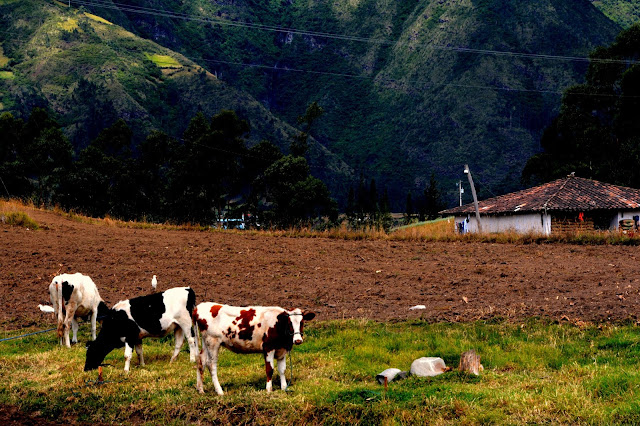

One night, he came across María Cotacachi. Later, they would walk together. But Imbabura had a hard time telling her how much he loved her. One day, he finally declared his love. Cotacachi confessed she had the same feelings.
As time passed, they would have a son called Yanaurcu who sits near his mother. There is a real mountain called Yanaurcu.


Today, the indigenous make offerings to María Cotacachi and Manuel Imbabura, hoping the two can ensure a good harvest.
It is said when Cotacachi has snow in the morning, it's because Imbabura came to visit her at night.

Wednesday, April 1, 2015

Shuar Indigenous People of Ecuador


The Shuar indigenous people of Ecuador were an eminently warlike people.

They were known as the feared Jíbaros, the wilds or ferals, and headhunters of the Amazon.


Formerly, after their wars, they performed a rite of reducing the head of his enemies.

This ritual is known as Tsantsa.


It was performed in order to preserve the enemy’s head as a trophy of war.

Today they claim the right to call themselves as Shuar, meaning, people, a person.


History of Shuar People


These dreaded “feral” people dominated the Amazon jungle to the late nineteenth century.

They lived mainly in the provinces of Morona Santiago and Zamora Chinchipe of Ecuador.


Shuar nation was never submitted by the colonizers.

The arrival of the Salesian mission, which gained momentum after 1930, led to the nuclearization of settlements and new forms of organization.


This culminated in the establishment of the Shuar Federation in 1964.

The Salesian missionaries began the process of Christianizing the Shuar.


The first missionaries were seized by the feared warriors and found their end in the hands of the Shuar warriors.

Although Western history does not indicate how many missionaries were killed and legendary transformed into tsantsas.


Nowadays the Shuar have left their warrior side and submitted to the pacification imposed by missionaries.

In this process, several Shuar fled to the south, and this way expanded the communities to different areas of Amazonian Ecuador.


Such as the provinces of Pastaza, Morona Santiago, Zamora Chinchipe, and to the territory that now corresponds to Peru.


Culture of the Shuar Nation


The traditional language of Shuar people is Shuar-chicham.

 They are nomads and subsist mainly on the horticulture of tubers, tending the farms until the harvest and then moving on.


This is supplemented by hunting, fishing and gathering which are the work of the men.

The agriculture and harvesting are for women.


Women are also in charge of children and housework, particularly of the preparation of chicha and kitchen.

The Shuar people traditionally use the system of slash and burn cultivation.


Hunting is their main source of protein, and they supplement their diet with fishing and gathering fruits, insects and plants.

However, currently most of the traditional hunting ground is being replaced by cattle pastures, which has resulted in the progressive depletion of the soil and reduced availability of land.


This has led to the introduction of a sedentary settlement pattern, the same that is producing changes in the socioeconomic system.


Traditionally the settlement was sparse, usually zoned according to kinship.


Wednesday, March 11, 2015

Spondylus Route at the Ecuador's Pacific Coast


Spondylus Route at the Ecuador's Pacific Coast was formerly known as the Ruta del Sol or Route of the Sun.

It is the road that borders the Pacific Ocean from northern Peru to northern Ecuador.


The route has countless attractions and multiple beaches.

The name of the route comes from the spondylus seashell, or red spiny oyster, that was very important for pre-Columbian cultures of Ecuador and even used as currency.


What Spondylus Route has to offer


The small towns with hotels, restaurants, museums and other attractions, together with bigger towns and gorgeous beaches sprinkled throughout the route make it irresistible and a must for a traveler.


There are possibilities and facilities aquatic sports like surfing, snorkeling, fishing and scuba diving among others.

Other attractions included paragliding, horseback riding, local cuisine and culture, the wonderful sunny weather and friendly people.


Every town has its distinct way of life, culture, and culinary riches.

The beaches, food and opportunities for relax and partying varies from town to town.


History of Spondylus Route

The Spondylus Route on the coast of Ecuador displays the cultures that thrived from 8000 BC. 

Some of these cultures as Bahia and Manteña were among the most experienced sailors.
 

They were known as the "Phoenicians of the Americas" and aboard of their wooden boats of the Ecuadorian balsa traveled all the way from Mexico to the north and to the southern Chile.


One of the most important objects of the trade was the sacred "the Spondylus shell". 


It was also known as "Mullu" in Quechua (native language of the Incas).


The shell was one of the most sacred and sought out items in ancient times.


It was marketed and highly valued by the chiefdom of Ecuadorian and Peruvian Andes.


The shells or their remains have been found in almost all major archeological discoveries of the west coast of South America, such as the tomb of the Lord of Sipan in northern Peru.


In the small town of Valdivia is a museum that is dedicated to the different cultures that habited the Ecuadorian Pacific Coast.


Where to go


The beaches and towns stretch from Huaquillas at the El Oro Province in the Peruvian border till San Lorenzo in Esmeraldas Province right next to Colombia.


The Spondylus Route runs through a total of five provinces, all with different kinds of culture, traditions, nature, cuisine, animals, attractions, and beaches.


Montañita is the party central and the capital of surf, popular with both national and international tourists.


Los Frailes beach located in the Machalilla Natural Park is famous for its beauty and a quiet place to enjoy the sun, sand and water together with the nature.


Salinas, la Ciudad Blanca, or the white city has five-star accommodations and all the luxuries a demanding tourist might want, including shopping opportunities.


Puerto Lopez is famous for the opportunity to go whale watching and also for the fun loving lifestyle that has attracted many international tourists.

Playas has the charm of an old time balneary and there are opportunities to go dolphin and bird watching in the mangroves from the nearby town of El Morro.


There are numerous small towns with quiet and slow rhythm of life.

And other bigger ones bustling with tourists, music, and fun.


If you are planning a vacation keep Ecuador's Spondylus Route in your mind.

Spondylus Route is sure to offer something special for everyone!


Friday, December 5, 2014

The Queen With The Frozen Heart - The Monster Awakens


A stony monster rose from the mountain in the twinkling light of the stars.

Sisa could not understand how it could possibly be Amarun.

The monster had the head of a snake and the feathered wings of a bird and a long feathery tail.

It looked like a statue of the feathered monster from the tales told to children to scare them.


Slowly she moved towards the stone figure.

The play of the shadows and light made it look alive and moving.

Like it were still breathing.

She touched the stone and for an instant it felt like feathers in her hands.


She heard the sound of the drums that Kuyllur was playing.

His brother, Lusiru, sang in a monotone voice and danced around the stony monster.

He was smoking a cigar made of fresh tobacco leaves and puffing the smoke over the figure.

The waving and weaving of the smoke over the statue made it look even more alive.


Like it was breathing smoke from its nostrils.

Sisa shivered and grabbed the stone harder.

Again she could feel the feathers and the beat of a large heart.

Scared she kneeled in the earth next to the monster and waited for what would happen.


Lusiru took a large swig of the bottle he had in his hand and sprayed the alcohol from his mouth over Sisa.

He kept chanting and waving the branches in his hand.

Dispelling the smoke and strong alcohol around in the night.

Weaving his footsteps to the beat of his brother’s drum he danced closer to the statue and puffed more smoke over it.


Then he took another swig of the alcohol and sprayed it over the stone monster.

He waved the branches in the air and urged the monster to wake up.

Urged Amarun, Sisa thought.

It was not a monster, it was Amarun.


Finding courage from the thought she stood up and walked to the stone figure.

Slowly she touched it again, feathers, warmth and a strong heartbeat.

She climbed to its back and grabbed hard.

Lusiru screamed to the air and hit the monster to the head with his branches, urging it to wake up.


Sisa felt the monster shaking under her.

Then it raised its huge head to the sky and roared.

She grabbed harder and got hold of a handful of feathers.


Opening its wings Amarun leaped to the sky.

To be continued...


This is the thirthieth part of the story.

To read the first part of the story, go to The Queen With The Frozen Heart 1  

To read the second part, go to The Queen With The Frozen Heart 2 

To read the third part, go to The Queen With The Frozen Heart 3

To read the fourth part, go to The Queen With The Frozen Heart 4

To read the fifth part, go to The Queen With The Frozen Heart 5.

To read the fourteenth part, go to The Queen With The Frozen Heart 14

To read the sixth part, go to The Queen With The Frozen Heart 6

To read the seventh part, go to The Queen With The Frozen Heart 7

 To read the eight part, go to The Queen With The Frozen Heart 8

To read the ninth part, go to The Queen With The Frozen Heart 9

To read the tenth part, go to The Queen With The Frozen Heart 10

To read the eleventh part, go to The Queen With The Frozen Heart 11

To read the twelth part, go to The Queen With The Frozen Heart 12

To read the thirteenth part, go to The Queen With The Frozen Heart 13

To read the fifteenth part, go to The Queen With The Frozen Heart 15

To read the sixteenth part, go to The Queen With The Frozen Heart 16

To read the seventeenth part, go to the The Queen With The Frozen Heart 17

To read the eighteenth part, go to The Queen With The Frozen Heart 18

To read the nineteenth part, go to The Queen With The Frozen Heart 19

To read the twentieth part, go to The Queen With The Frozen Heart 20


To read the twenty third part, go to The Queen With The Frozen Heart - At The Mouth Of The Cave

To read the twenty fourth part, go to The Queen With The Frozen Heart - The Visiting Star

To read the twenty fifth part, go to The Queen With The Frozen Heart - Time To Leave The Home

To read the twenty-sixth part, go to The Queen With The Frozen Heart - A Suitable Wife

To read the twenty-seventh part, go to The Queen With The Frozen Heart - Down In The Dungeons

To read the twenty-eight part, go to The Queen With The Frozen Heart - Savouring The Chicha

To read the twenty-ninth part, go to The Queen With The Frozen Heart - Flying With The Stars