Monday, October 13, 2014

Potato Spinach Soup


I love a good potato soup!

One of my favorite ingredients or sides is potato.

It’s so versatile and goes well with almost anything and everything.

This potato and spinach soup is healthy, hearty and delicious.

It is the only way I can get my son to eat his spinach and enjoy it.

Hope it will be your family’s favorite too!

This recipe guarantees that spinach changes in your house, from this...

To THIS!

INGREDIENTS
(For four people)

2 pounds potatoes
200 grams of spinach
1 onion
1 cup of milk
4 ounces unsalted cheese (queso fresco)
1 tablespoon of butter
Salt
Pepper
Cilantro

PREPARATION:

1.   Peel and cut the potatoes into cubes.
2. Fry the chopped onion until it is soft,
3. Add the potatoes, pepper, salt and water until it covers the potatoes. 4. Let the mix boil,
5. Wash and chop the spinach, removing the stem.
6. Add the spinach and cheese when the potatoes are soft.
7. Keep everything in the fire a few minutes, until the cheese has melted.
8. Wash and chop the cilantro, add it to the soup after taking it from the fire.


Serve hot and ENJOY!

Sunday, October 12, 2014

Day of Interculturality and Plurinationality - October 12th

In Saquisilí, province of Cotopaxi, the two women are wearing traditional clothing typical for the area.

For decades Latin Americans have commemorated October 12th as the Day of the Race.

This is a date when the discovery of America by the Genoese Christopher Columbus is remembered as Columbus Day.

Group of indigenous people in Latacunga, the Capital of province of Cotopaxi. Latacunga is known for their yearly Mama Negra carnival.

The date was originally a celebration of the mix of the races that came with the arrival of Europeans, especially from Spain. 

For years it has meant a classification of human beings into races based on the skin tone, hair or skull shapes, and a series of racial bias.

A fisherman in Puerto Lopez, a fisher town in the province of Manabí. The town is famous for the whalewatching trips and very popular among local and international tourists.

On 2011 Ecuador declared October 12th as the "Day of Interculturality and Plurinationality" to correct the significance of this date that historically commemorated the discovery of America in 1492.

 In its considerations, the text by Ecuador’s President Rafael Correa, notes that in Ecuador "various nationalities coexist" Indigenous people "are entitled to support and maintain their own institutions."

A candidate for Kichwa Beauty Queen contest held annualy during Tena's festivities. Tena is the capital of Napo province in the Amazonic part of Ecuador. 

He also argues that the structures of the country "are still grounded on colonial criteria."

For this reason, this date is decreed as "Day of Interculturality and Plurinationality, designed to recognize and rectify the true meaning of the event of October 12, to promote dialogue between different cultures and knowledge, strengthen national unity in diversity inclusive of building the new state of peace and justice, "the statement said.

Local people at their barrio's (neighbourhood's) minga (voluntary communitary work) in Northwestern Quito. Quito is the capital of Ecuador.


Similarly the government urges the United Nations Educational, Scientific and Cultural Organization (UNESCO) and the International Labour Organization (ILO) to "update a true universal calendar intercultural nature with the help of all nationalities and aborigines.

In several Latin American countries the name of the celebration of October 12 has been changed.

Indigenous people resting during a political meating held in front of Quito's San Francisco Cathedral in the Colonial part of the city.

In 2001, Venezuelan President Hugo Chavez declared October 12 as the "Day of Indigenous Resistance" noting that on that date began the "genocide" of native peoples of America.

Chile has called it the 'Day of Discovery of Two Worlds'; Costa Rica calls it the, 'Cultures Day'; and in Peru October 12th is called the 'Day of Indigenous Peoples and Intercultural Dialogue'. 

An Afro-Educadorian student in class wearing her school uniform.


In Bolivia, President Evo Morales called it the 'Day of Mourning' because of the poverty, disease and hunger that the European invasion of America brought.

But later on he established it as the 'Day of Indigenous Resistance'.

Indigenous girls in Tena wearing the traditional pacha dress and face painting.


In Argentina October 12th is called the 'Day of Respect for Cultural Diversity', while in Spain it is called 'Columbus Day' like in the States.

The change of the name in Ecuador seeks the restitution of values of indigenous nations and their members.

A way of peaceful coexistence.

High School students perform a traditional Afro-Ecuadorian dance from the Valle de Chota area during a festivity.

Friday, October 10, 2014

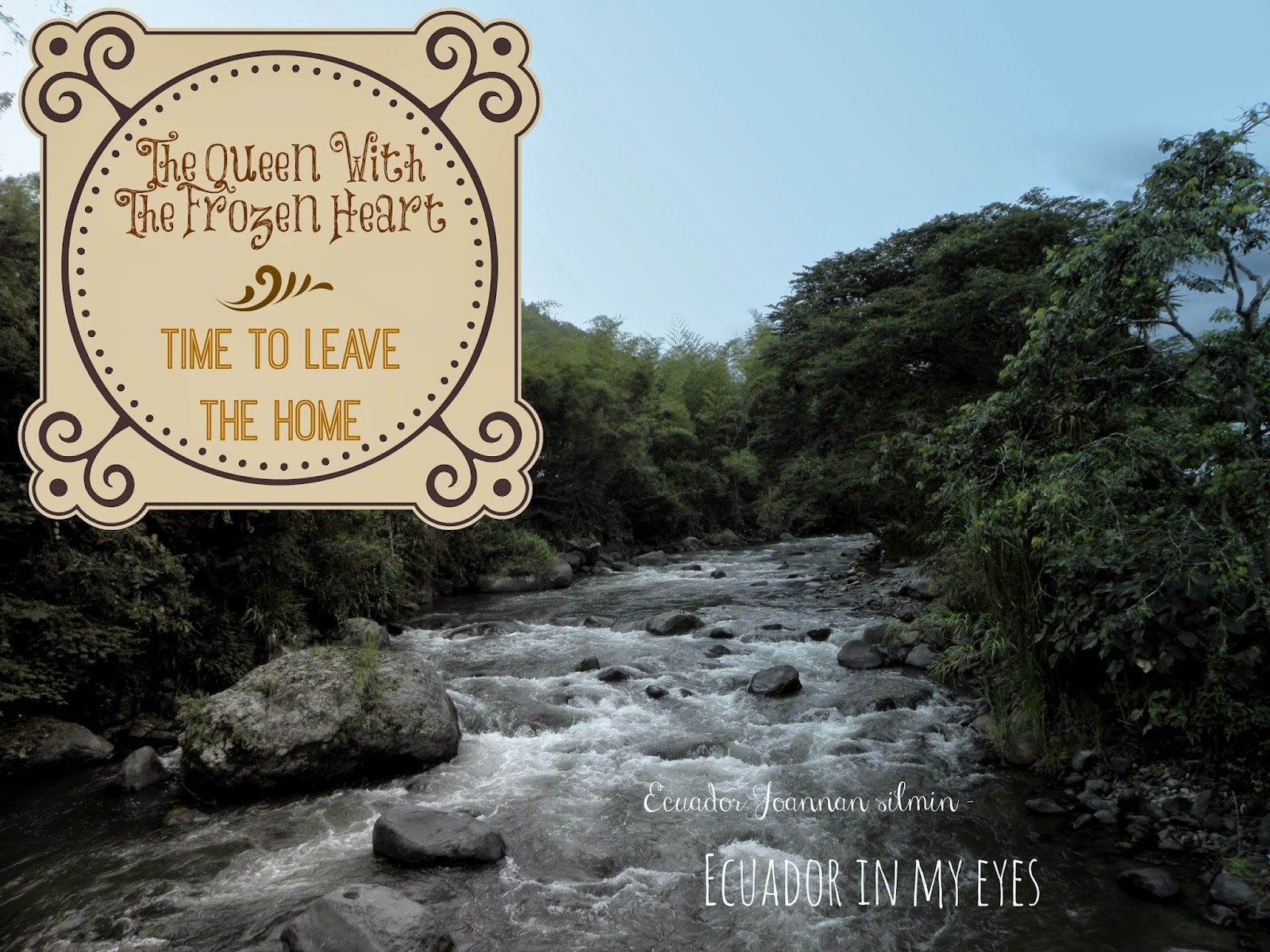
The Queen With The Frozen Heart - Time To Leave The Home


Silently the warriors passed under the canopy of the giant trees.

The early morning sun shone golden through the leaves.

The men warmed themselves in its rays while walking from the waterfall to the jaguar men’s cave.


 Their magic fluttered in the air, jumped from tree to tree and skulked behind the green growth of the forest floor.

The vats of chicha were heavy on their backs but they trudged on.

They have promised Iluku to have everything ready for her at the cave’s mouth by the night fall.


The walk was long but they did not falter.

It was not in their nature.

Nor was to care about the cold or the heat, the insect bites or the sun in their eyes.

They were warriors and their skills were needed, tonight.


Sisa stared at the sun’s play on the river.

She had not been able to forget Amarun or shake the feeling of threat.

The village was quiet, everyone worried about the faith of their men.


What had happened after they left?

Why had not they returned with the snakes?

Her magic had finally taken the shape of an ocelot.

Small, but fierce and dangerous, feline hunter.


Not something that the village was accustomed to see as a female’s guardian.

It purred and pushed its head against Sisa’s feet, trying to calm her down.

- My soul can’t rest, she petted the magic, not until I know what happened.


- And you won’t be able to rest then either, her magic answered her.

It had gotten its voice as soon as it had chosen a definitive form.

- What do you mean, Sisa’s voice trembled.


- You will only want to help, the magic laughed, you say that you will be at rest when you know what has happened. But when you do, you won’t be at rest until you can help and make everything right. That is your nature, embrace it.

She shook her head.

It was not a female’s place to change the world.


Her place was at home, taking care of the hearth.

- It is time you accept who you are, her magic demanded, you cannot keep hiding and living here anymore. Not with a magic like this.

Sisa looked around her.


She saw the worried faces of the women, the silent looks and eyes evaluating her.

Their backs so eloquently shown to her.

The way the women huddled together, closing their circle and shutting her out.


- You don’t belong here anymore, the magic repeated, and they all know it.

- What am I to do, Sisa bursted and then drew a shuddering breath.

- You know it, the magic shook its head, take your things and find the queen. She is the only one who can help you!


Inside the cave the king roamed in his cell.

He could hear his men, their desperate sobs when they remembered their homes and families.

There was no more hope, nothing to look forward to.


- Tonight, the jaguar kasike had told them, tonight we feast. And you will be our main course.

To be continued... 


This is the twenty fifth part of the story.


To read the first part of the story, go to The Queen With The Frozen Heart 1  

To read the second part, go to The Queen With The Frozen Heart 2 

To read the third part, go to The Queen With The Frozen Heart 3

To read the fourth part, go to The Queen With The Frozen Heart 4

To read the fifth part, go to The Queen With The Frozen Heart 5.

To read the fourteenth part, go to The Queen With The Frozen Heart 14

To read the sixth part, go to The Queen With The Frozen Heart 6

To read the seventh part, go to The Queen With The Frozen Heart 7

 To read the eight part, go to The Queen With The Frozen Heart 8

To read the ninth part, go to The Queen With The Frozen Heart 9

To read the tenth part, go to The Queen With The Frozen Heart 10

To read the eleventh part, go to The Queen With The Frozen Heart 11

To read the twelth part, go to The Queen With The Frozen Heart 12

To read the thirteenth part, go to The Queen With The Frozen Heart 13

To read the fifteenth part, go to The Queen With The Frozen Heart 15

To read the sixteenth part, go to The Queen With The Frozen Heart 16

To read the seventeenth part, go to the The Queen With The Frozen Heart 17

To read the eighteenth part, go to The Queen With The Frozen Heart 18

To read the nineteenth part, go to The Queen With The Frozen Heart 19

To read the twentieth part, go to The Queen With The Frozen Heart 20


If you wish to read the twenty third part, go to The Queen With The Frozen Heart - At The Mouth Of The Cave

If you wish to read the twenty fourth part, go to The Queen With The Frozen Heart - The Visiting Star

Thursday, October 9, 2014

Independence of Guayaquil - October 9th


To commemorate the October 9th, the anniversary of the independence of this noble city of Guayaquil, it is necessary to pay tribute of gratitude to those heroes who gave us an example of courage and patriotism.

After all, they gave us the most precious inheritance for man, his freedom.


In September 1820, young members of the Venezuelan military battalion Numancia: Letamendi Miguel, Luis Urdaneta y León Febres-Cordero arrive at the port en route to Venezuela.

José de Antepara, a leader of the freedom movement, recognizes them as supporters of freedom and committed to the cause, they suggest contacting officials Grenadier Reserve, Peruvian battalion quartered in Guayaquil.

The only way to do it secretly is to gather in a society’s party.


Isabelita Morlás, young daughter of their host, José Villamil, the treasurer of the council, suggests her mother, Doña Villamil Garaycoa, might organize a ball.

This gives the required excuse for the meeting to happen. 

On Sunday, October 1st by night, Villamil and his wife offered a party at their home in the Malecon Avenue.

They are known to fraternize with the Numancia and the Grenadiers.


Without attracting the attention of the others, Antepara secretly meets with supporters of the emancipation.

This gives the opportunity to form contacts with the people in Guayaquil. 

There are twenty total of conspirators; the leader of them is Villamil.

- This is the Forge of Vulcan! Antepara forecast.


There are concerns about the cavalry squadron and artillery brigade in nearby Daule.

The participants feared that Vivero royal governor of Guayaquil has discovered the conspiracy.

On Thursday, Friday and Saturday conspirators continue their work of recruitment.

They finally decide to make the revolution immediately, citing as one watchword sloganGuayaquil for the Fatherland!”.


On Sunday, October 8 in the morning the governor, alarmed by the rumors, holds a Board of War and ordered the Grenadiers to patrol the streets of the city.

Meanwhile in the house Villamil the patriots finalize preparations.

They decide on October 9th at 2 am as the key time of the events.

Vivero is vigilant at barracks until late Sunday night but as he finds nothing, finally new retires to rest.


Officers Gregorio Escobedo, Hilario Alvarez, Damien Nájera and José Peña had joined the movement.

At dawn on Monday, October 9th Nájera commander seizes Torres Valdivia chief of artillery and seizes the keys

Meanwhile Febres Cordero with fifty grenadiers, surprised the watch officer of the artillery, capturing the troops.


Antepara and Urdaneta, with 35 men, vanquish the squadron commander of Daule who dies in the fight.

The rest of the men support the freedom cause.

Colonel García del Barrio, the governor Viveror, Colonel Elizalde and Friar Querejasú are all taken prisioners.

The boats patrolling the river were also imprisoned along with their commander Villalba.

By the morning the people were overflowing the streets and squares to know the facts and to hail freedom.

The council meeting proclaimed independence and José Joaquín de Olmedo was named Political Head and Gregorio Escobedo  the Chief Military Commander.

Both were sworn immediately to the office.


So this is the almost bloodless independence of Guayaquil, which opened definitive emancipation of the former Viceroyalty of Quito and made possible the victory at Pichincha.